
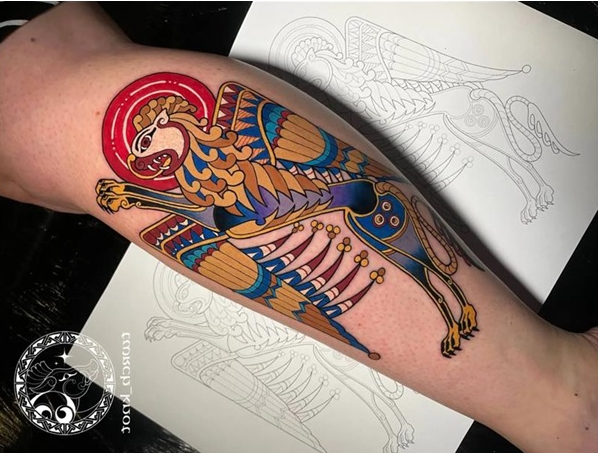
There is something enchanting indeed about the Celtic tattoo designs that people cannot resist. The only thing that might be the reason for this is the beautiful elaboration of the intricate knotwork, which gives the illusion of endlessness or the profound meaning associated with the design that is still rooted in ancient customs.
In any way that the designs allure a person, they are still in the list of most favourite ones for a long time, and it is simply because they not only look good but also carry with them the genuine history, spirituality, and cultural significance that is still acknowledged today.
The Rich History Behind Celtic Tattoos
Celtic art originated during the Iron Age, when Celtic tribes initially settled in regions now known as Switzerland, France, and the Czech Republic, and later spread across much of Europe began using art as a form of visual and symbolic communication rather than simple decoration. Through these motifs, they expressed emotions, beliefs, and major life events, creating a bridge between the earthly world and the spiritual one.
Originally, Celtic culture extended across a vast territory, from Anatolia to Ireland. With the expansion of the Roman Empire, many Celtic populations were gradually assimilated, leading to the loss or transformation of numerous cultural elements. Today, Ireland, Scotland, and Wales remain among the few parts of Europe where Celtic culture has stayed more alive and recognisable, largely because Romanisation in these regions was more difficult and was never fully imposed.
Celtic Knot Symbolism Explained
Celtic knots have no beginning and no end; they can be interpreted as eternity, the interconnection of lives, and the universal and thus continuous change. The concepts of life (birth, death, and rebirth), seasons, and the coexistence of the physical-spiritual worlds are some of the ideas that are being represented with those knotted and intersected patterns.
Furthermore, there are particular meanings attributed to varying knot styles. The trinity knot conveys the earth, the sea, and the sky as three worlds. A shield knot was thought to be a protector’s source. The loveknot denotes the union of two souls into one. We are living witnesses in Aranos, Ireland, where many people have today opted for these designs as they believe these signify their heritage or spiritual beliefs.
Popular Celtic Symbols and their Meanings
The combination of the circle and the Christian cross in the Celtic cross seamlessly unites the two different aspects of faith — the pagan and the Christian ones. The triskelion, with its three arms coiling outwards, symbolises the movement, the progress, and the three realms of existence. The Tree of Life is one of the designs that can be found all over. It symbolises strength, wisdom, and the interconnectedness of all living things.
Each of the Celtic animal symbols has its own meaning as well. The stag is a sign of manliness and freedom, whereas the hound indicates faithfulness and defence. The raven is linked to the future and battle. Moreover, selecting an animal that resembles your character gives the tattoo even more significance.
Celtic Tattoo Placement and Design Considerations
Now and then, the armbands and wrist bands come to mind when one thinks of the ancient knotwork of the Celtic people. The placements make a circular pattern that goes well with the never-ending loops of the knots. Big and intricate artworks could be rightly assigned to the back and chest areas.
While considering the thickness of lines that will be used for your Celtic tattoo, the overall thickness of the lines should be taken into account as well. The majority of the Celtic designs are made up of lines, and if the lines are too thin, then they might disappear over time. One of the most important factors in making a tattoo clear and readable for a long time is a skilled tattoo artist who has years of experience working with Celtic designs.
Picking the Right Celtic Tattoo for You
To begin with, consider the significance of your tattoo. Are you going to simply flaunt your Celtic heritage, or will it symbolise your spirituality or even your religion? Perhaps you want to memorialise a life-changing moment. Once the meaning is clear, you will be able to choose the most suitable Celtic tattoo symbol that truly reflects your vision. For a deeper understanding of traditional Celtic symbolism, you can explore this detailed guide on Celtic tattoo meanings and symbols from a trusted tattoo resource.
The size indeed is much more important in Celtic designs than, for instance, in other tattoo styles.
The detailed linework needs to be of sufficient size to be clear and readable. In contrast, the very small Celtic knot might get indistinct; the same design, when done larger, will remain sharp and beautiful.
Tattoo artists should be carefully researched. Celtic designs demand particular technical skills: the lines have to be neat and uniform, the spaces to be absolutely right, and the patterns to be perfect. Seek the Celtic artists or those with robust portfolios illustrating detailed linework in their tattoos.
FAQs
What do Celtic knot tattoos symbolise?
Celtic knots symbolise eternity and the cyclical nature of life.
Do Celtic tattoos have to be black?
Traditional Celtic designs are monochromatic, while modern interpretations often involve colour.
How do I choose the right Celtic symbol for my tattoo?
Research the meanings behind different Celtic symbols; choose one that speaks to your own personal beliefs.
Conclusion: Timeless Allure of Celtic Tattoo Tradition
The ability of Celtic tattoos to be personal as well as universal is what makes them special. The symbols have been interpreted in various ways for centuries, yet still, every person who gets one reads it through their own life. Your Celtic tattoo is your story, but at the same time, it is a bridge to an ancient art form.

